
What did the creative process look like and steps it took to reach the digital world we live in today?
Before any of these experiments began emerging in the world, the word of mouth was the only way to communicate over long distance. That required a mail carrier on horseback to travel to the given destination and deliver it by hand. Then, that process would be repeated to the return address. This form of long distance communication needed to change.
1753 saw one of the first experiments of the early “telegraph” that used a method called point to point. This allowed messages to travel wire to wire across distances. This also meant that 1 wire was used for 1 letter which was completely impractical but a successful step in advancing this machine.
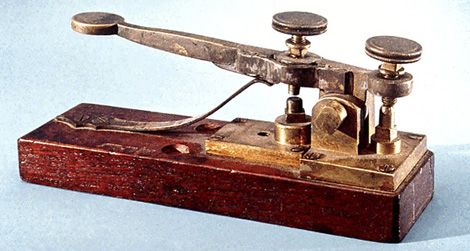
The telegraph that the world knows today was then invented in 1838 in New Jersey most famously by Samuel Morse. The idea is that there would be individual buzzes sent through a wire and an operator on the receiving end would have to identify the order of beeps and pauses and then form a sentence. This was then told to the correct recipient.
Next, comes Alexander Graham Bell whose telephone invention secured a patent in 1876. This recorded a voice directly on a line and transferred it to the end of the line. The problem was that the longer the line, the quieter the voice got. This meant that a really long line would have been not understandable. This is known as noise, which could not be separated from the signal, making it analog.
Eventually, the noise was able to be removed from the signal creating the digital telephone. This was done through the invention of an Analog Digital Converter (ADC) which used analog waves over time to then assign each wave to a number and then would later be put back into a Digital Analog Converter (DAC) to repeat the signal at the end of the wire.